Saturday, February 11, 2012

Maniototo meandering: NZ Day 16

The meteorological situation in the morning was no different to the night before, and when I awoke at 9:00am the rain was still very much pouring down on the Maniototo Plain.  However I wasn't too upset - today was a day set aside to explore Ranfurly and surrounds, so we wouldn't be facing a wet rail trail on the bikes.  I got out of bed and stumbled down the hallway, to find out hosts Gary and Chris patiently awaiting us with a magnificent cooked breakfast.  I felt a little bad for sleeping in so late, oblivious to the fact that they'd cooked up such a morning feast - but of course they were in high spirits.  We all ate breakfast together and continued on from where we left off last night, eating and being jolly.

Jer and I had no solid plans locked in for the day - the only scheduled activity was having a shot at curling in the nearby town of Naseby, leaving the rest of the day to do whatever we pleased.  Jer was feeling a little sick again, so we slowly ambled through the rain to the main street, to see what was happening around town and have a cup of coffee.


The Ranfurly Hotel was the venue for our first coffee, and it wouldn't be the last time we'd be there today

This chick was totally making eyes at Jer, but he was playing hard to get and trying not to blow his cool

Feeling a little more lively after a strong coffee, we wandered around to see what was happening in Ranfurly.  It was Saturday morning, with a lot of local people in town, having coffee, doing their shopping and generally running errands.  The vibe was very rural, with one notable exception - lots and lots of bikes.  All up and down the main street there were bikes whizzing past, everything from lone tourers to large groups riding hired bikes.  I generally go touring either by myself or with one other person, so I was a bit intrigued by all the large groups we saw on the trail.  A curious thing was that I'd seen these big groups either only on the trail itself, or only in the main street of towns - their approach seemed to be focused solely on riding the trail just for the sake of the trail, and not exploring the greater sights and history of Central Otago.  All along the way we'd see groups ride into a town, keep to themselves, then ride quickly out again, sticking only to their designated route and strict timetable.  It was all a bit perplexing to me - the best parts of our rail trail experience had been when we'd ventured off the trail and taken the time to dig a little deeper (mining pun semi-intended) into Central Otago.  We were trying to experience the Otago Central Rail Trail in the spirit that the original line was constructed over a century ago - back then the rail line wasn't a destination in its own right, but a conduit cut through the rugged terrain to open up the remote towns of Central Otago.

Kiwi kitchen
With the rain still falling, we headed back to Maniototo Lodge B&B, where Chris was in the kitchen cooking up yet more baked treats.  I must have looked a little on the emaciated side after being on the road for a few weeks - as soon as I set foot in the kitchen Chris said "I'll make you some some scones" and whipped up a batch of hearty date scones, seemingly from thin air.  Jer and I spent an hour or so chatting with the very affable and hilarious Chris - it turns out she used to be an English and history teacher, so Jer and I were making the most of this to get ourselves schooled not only in Otago history, but also the broader history of New Zealand.  It was enthralling to hear about the history of a nation only 3 hours flight from my home, yet about which I really knew very little.  All the while, local people were popping in to say hi to Gary and Chris as they went about their Saturday morning errands, with each new visitor necessitating a fresh cup of tea and more cake.  It was like being in an episode of Kiwi Kitchen meets A Country Practice, and an utterly charming experience of life on the Maniototo Plain.

I had to be quick to get a photo of Chris cooking - she was like some kind of cake ninja, brewing up sweet treats in the blink of an eye

After lunch Jer went for a sleep for a few hours, and I wandered back into Ranfurly for more of a look around.  Despite the dreary weather, I was happy to be indulging in one of my favourite pastimes - strolling about doing nothing in particular at all.

The road out of Ranfurly.  Maniototo Lodge is right on the edge of town in a quiet rural location, but still only a five minute stroll to the centre of town

The old railway crossing signs have been altered to reflect the new use of the rail trail - nothing seems to ever stand still in Central Otago, history is constantly being re-used and re-invented

Even on a Saturday morning out of tourist season, Ranfurly was packed with bikes.  Bikes at the cafe...

...bikes parked neatly at the pub...

...and bikes at the museum.  Ranfurly must really get pumping over the summer months, when thousands of people traverse the trail

I treated myself to a little walk along the trail, as a lot of locals seemed to be doing as well.  As with cycling through the Maniototo Plain, I reckon walking the trail would also be an entirely pleasant experience


Hidden away in the goods shed opposite Ranfurly station I found a display of restored tractors.  It didn't seem to be signposted, I just stuck my head in the door to see what was in the building, and was pleasantly surprised


Walking around the country lanes out of town, I stumbled upon this old mechanical grader

What the cabin lacked in creature comforts, it made up for in excess steering wheels

The view from the rail trail to Maniototo Lodge

This photo wasn't staged.  When I got back to the house Jer was lying in bed, fully clothed including hat, playing piano.  This meant he either felt better, or had gone wrong in the head, or possibly both

Curling o'clock
Later in the afternoon, Chris left to go to Dunedin for a few days, which left Jer, Gary and I back at the Lodge.  The decision was made to get up to some man stuff, and the first order of business was curling at nearby Naseby.  One recurring theme in Central Otago was the willingness of people to drive us around everywhere so we could sample places off the trail.  No matter where we wanted to go or at what time, someone was always quick to offer a lift or the use of their car for the journey. Today was no exception, and we all piled into Gary's car and set off for an afternoon of adventure.

After a short drive from Ranfurly to Naseby, we pulled up at a large inconspicuous looking shed on the edge of town.  Curling was something I've always been fascinated by, and always wanted to try, but now that it was actually about to happen I have to admit I felt pretty tense.  Jer was even more anxious than me, to the point he was really freaking out, saying "I'm just going to watch man, this is too hardcore" - it was the first time I'd ever seen him properly freak out and not want to do something.  Before we had too much of a chance to chicken out, we paid our money (only $20 for tuition and and an hour on the ice), and nervously watched an introductory video, our brains desperately scrambling to take in the various rules and conventions of curling.  Stepping out onto the ice was like stepping into a giant freezer - the ambient temperature is close to freezing, and as per usual we weren't at all dressed for the occasion.  We must have looked pretty awkward as we received our tuition and had a few test slides of the 20kg stones.  Learning time was soon over, and it was time for the main event - the biggest showdown the sport of curling has ever seen...

In a tiny country town in the middle of New Zealand there's an Olympic standard curling rink, apparently the only one of its kind in the Southern Hemisphere.  Once again, Central Otago continued to dish up the baffling surprises

Jer receives some tuition in the ancient and noble sport of curling.  One theory is that it was started by bored bridge builders chucking rocks around between tasks - a theory that I don't necessarily believe, but choose to subscribe to anyway

Jer unleashes his mad curl for the first time - history in the making captured on film

Curler's eye view of the action.  This is the best sport you will EVER try

Back in Australia when I mentioned that we'd be curling in Naseby, people would say "oh yeah, that's like lawn bowls on ice" - the reality is that curling is nothing like lawn bowls at all.  The physics of sliding the huge stones around on the ice is quite bizarre, with a surprisingly delicate touch is required.  The game is also steeped in tradition, and even at this casual level we found ourselves being more formal, and swearing a lot less than we generally do.  The scoring system makes for a competitive game, and after an hour out on the ice, I prevailed with a score of five to three.  Curling is by far the most addictive and strange sport I've ever played - after we finished we couldn't stop smiling, and were both pretty much ready to throw our bikes in the bin and become full-time curling guys.

Instead of heading back to Ranfurly, Gary suggested that while we were out in the car we might as well go for a drive around, and set off for a magical mystery tour of the Maniototo Plain.

Climbing the hills high into the back country of the Maniototo

I'm not sure if these were outstations or abandoned houses, but the remote corners of the Maniototo were dotted with old buildings, mines and unused infrastructure dating back well over a century

It turned out that as well as being the consummate host, Gary was also quite the skilled tour guide, painting a vivid picture of the area's history laced with his dry humour, and building suspense as we climbed further up into the remote ranges overlooking the Maniototo.  I'm a guy who likes to know what's going on, and I think Gary saw this and was playing on it.  As we bounced across the hills I asked where we were going, to which he simply replied "over there".  I saw some houses and trees in the distance, and asked if it was a town, to which he replied "you'll see".  I'm often accused of being economical with the facts on a tour, particularly about distances and climbs - now I was getting a taste of my own medicine, and I must admit I was quite enjoying it.

After a while we ended up at a group of large austere buildings.  This place was once a sanatorium for tuberculosis patients, out here in the middle of nowhere.  I got the vibe that it must have been a pretty joyless institution to be sent to

The old sanatorium was now owned by some kind of religious organisation.  The bleak institutional vibe was no less foreboding, as were the numerous signs warning people to keep out

We were driving through a long abandoned gold mining settlement called Hamiltons, past old buildings, sluicing pipes and mine workings.  The old mine sluicings were immense, with the landscape forever bearing the gruesome scars of this incredibly destructive mining technique.  Surprisingly, the original system of sluicing dams and pipes still appeared to be functional, with white fans of high pressure water jetting out of holes in the rusted pipes.  Continuing along an increasingly rugged and muddy trail through the hills, we eventually pulled up at a gate on the hillside.  Gary stopped the car and cryptically said "Go for a walk down there.  Y means years, M means months, D means days and H means hours".  We got out of the car in the freezing cold and rain and tentatively walked down the overgrown track.

Jer strolls down the path - towards the stone-walled Hamiltons cemetery

The cemetery was overgrown with golden grass, filled with crumbling headstones.  On such a bleak day, this place was very sombre

This is what Gary was cryptically referring to earlier - a plaque listing who is buried here, and how long they lived.  This really hit home how hard life was back in the olden days of Central Otago, with many people living only for a few hours, days or months, and nobody living to an old age.  As a parent with two young kids, I found this place very sobering and sad, and reflected on how thankful I am for the conveniences of modern society that not only make us comfortable, but also keep us and our children alive

A half-dead pine tree stands sentinel over the pioneer graves


After the cold of the cemetery, we hopped back into the warmth of the car and slowly made our way down the rough bush tracks, back towards Ranfurly.  What struck me most about the back country of the Maniototo Plain was the remoteness of it all.  It appears that much of the area is devoid of roads and settlement, and as such getting anywhere takes a long time, even by car.  If anything were to go wrong out here, help would be a long time coming - for example, if you were to break your leg in some kind of camping related mishap, your friend could be forgiven for simply going back to sleep until help arrived.  It's a big country.

Bouncing down a bush trail amongst the ruins of old buildings brought one of the most gloriously anachronistic moments of the tour.  Radio reception around the hills was patchy, and just as we stopped to take this photo, the radio suddenly sprang loudly into life - with Mr Boombastic by Shaggy

One of the original water sluicing cannons, powered only by static head.  For such a simple device, the destructive power of this thing is phenomenal, and the landscape all over Central Otago still bears the scars

The weather on the Maniototo Plain that week was bizarre - huge banks of cloud that just seemed to rattle around in the valley, unable to escape over the surrounding mountains.  It was entertaining to watch, but I was secretly hoping it would clear up by the morning

Ale trail
Returning to Ranfurly, we headed straight to the Ranfurly Hotel, to finish our day where we had started.  We'd visited the front bar that morning, which I assume is where the tourists riding the trail go - tonight we went to the back bar, and seemed to be the only out-of-towners in there.   Still, the atmosphere was friendly and relaxed, and I finally had what I'd been craving since I'd arrived in New Zealand - a good old-fashioned pub meal.  Sitting in the local's bar we didn't want to embarrass our host, and were doing our best at drinking the enormous bottles of Speight's ale everyone else was having - but being a pair of lightweights, we were really struggling.  As we sat there chatting, a stream of people were stopping by the table to chat to Gary.  We met one local guy called Wilson, who looked like he had spent the day getting comprehensively "refreshed", to say the least.  When Gary told him we were riding to Middlemarch the following day, he turned to us, his face a picture of sincerity, and said earnestly "watch out for the bloody... bloody... gnomes!"  Gary said "what?", and Wilson replied "The gnomes.  The bloody... gnomes!" And with that Wilson just disappeared.  We sat there looking blankly at each other for a few seconds, until it finally clicked to Gary what Wilson had been on about - they were apparently filming The Hobbit in the town of Hyde, where we'd be cycling tomorrow.  As bizarre and confusing as he was, meeting Wilson was a highlight of the tour we still talk about, and something that just wouldn't have happened had we not taken the time to get involved with the engaging locals of the Maniototo.

I've heard the rail trail referred to as the "ale trail" based on the numerous pubs along the way.  Even I was getting into the spirit of things - in Central Otago I had a beer or two every night for five nights in a row, a feat I've not achieved since my university days

After a couple of beers we headed back to the Lodge and sat around chatting for ages - sampling one of the famous Central Otago Pinot Noir wines by a roaring fire.  I ended up going to bed much later than I expected, and the following morning we'd be getting back on the bikes to complete the rail trail, and indeed our whole tour of the South Island of New Zealand.  

When I was originally planning the rail trail section of our ride, I thought we'd blast through the trail in a couple of days, which I'm guessing is probably what most people do.  That all changed with the persuasion of my friend Ross from Cromwell, who had convinced me to leave the schedule to him.  It turns out that was the best decision we could have possibly made, and thanks to him we got to experience the very essence of Central Otago.  By scheduling some time to do nothing in particular, we'd had unexpected experiences and spent time with people that provided colossal insights into the region. Taking our time traversing the rail trail had certainly paid dividends so far, and I was determined to make my final day in Central Otago last as long as possible - and maybe it would even live up to it's title as "the driest part of New Zealand". Maybe...

Sunday, January 29, 2012

Rolling into Ranfurly: NZ Day 15

After a night of deep and relaxing slumber at the Omakau Commercial Hotel, I awoke to the sound of wind howling around the old building and rattling the window panes.  I got up and peered through the curtains at the dark and ominous sky.  Throughout our trip I had been able to determine wind direction by using the ubiquitous All Blacks flags still flying all over New Zealand, but on this morning the flag behind the hotel wasn't helping me - it just seemed to be frantically revolving at 360 degrees around the flag pole.  It appeared as though we'd be in for a meteorologically challenging day, but I wasn't terribly concerned.  In fact, I quite liked the gloomy weather as it added another dimension to our Central Otago exploration, just as it had on our Clutha River adventure - something about being stuck out in the weather on the vast plains added to the bleak feeling that must have been reality for the many miners living out there in tough conditions back in the olden days.

Our destination for the day was the Central Otago town of Ranfurly, about 60km further along the trail.  We headed downstairs to the grand old dining room at the hotel, where I fuelled up on the massive breakfast spread.  It was probably going to be a long day with all the sightseeing and exploration we'd be doing along the way, so just for good measure I decided to follow up breakfast with a second breakfast.  Since I was so close to getting the breakfast hat trick, I decided to back it up with breakfast number three, before pushing our bikes into the street and pedalling our bikes a short distance back to the site of the old Omakau railway station.

Leaving the Omakau Commercial Hotel - old school Central Otago hospitality at its finest

The weather at Omakau station looked like it could go either way - although I suspect it was skewed about 52% towards rain

Passing through a culvert a little way out of Omakau.  The trail was quite wet in places with a few puddles, but the surface remained firm with plenty of grip

Unsure about the weather, we set a fast pace for the first 20km or so, with a view to getting as far as we could before the rain started

Being on the trail early has advantages - we only had to pass a couple of riders out of Omakau, and then we were riding in solitude

The trail continued north-east out of Omakau, undulating very gently across the mostly open farming landscape.  We appeared to be riding across the floor of a wide valley, with the schist covered hills a few kilometres away on either side of us.  We very quickly arrived at the town of Lauder and whizzed straight through, as it was too early for a coffee, and the weather still looked threatening.  The cyclists who had already stopped at the Lauder cafe gave us a friendly wave as we passed by.

Tunnel time
After a while the trail turned slightly more to the east, and suddenly we left the farming land behind and were faced with the rocky hills of the Raggedy Range.  This section of the trail was certainly the most dramatic, and probably most easily recognised, where the trail passes through deep cuttings and over huge gorges.  Our first major bridge crossing was over the Manuherikia River on a majestic stone and girder bridge that cut a graceful arc through the air to the foot of the range.

As soon as we crossed the gorge we found ourselves with the imposing schist ranges of Central Otago towering above our heads...

...and in the other direction was gentle farming land.  It certainly was a quick transition between landscapes

The original infrastructure along the Otago Rail Trail is a thing of great beauty.  The fact most of this was designed only with pencil and paper, and was built by hand is testament to the skills of the olden day construction crews

Jer among the schist

I make my way through a cutting towards Poolburn Gorge, dwarfed by the huge hills

As we entered the Poolburn Gorge we could see blue sky back over Omakau, but looking east towards our destination all was very dark and ominous

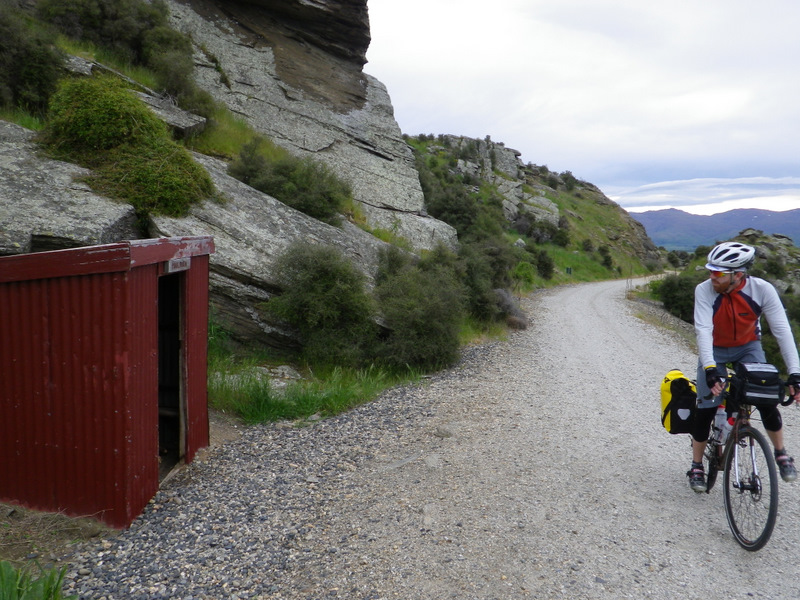
I stop to inspect a ganger's shed nestled amongst some large schist boulders

It wasn't an information stop, but I'm guessing by the earth floor and fireplace that the Poolburn ganger's shed is probably an original shed in its original location.  I found it no less fascinating and informative than its information panel bearing cousins elsewhere on the trail

Soon the cuttings became much deeper.  I've said it before, I'm excited by riding through cuttings - probably because a cutting is technically 3/4 of a tunnel...

...and I didn't have long to wait until we had arrived at the Poolburn Tunnel No.2.  Jer was less than delighted at the prospect of entering the tunnel, due to an unpleasant incident involving some bats that occurred at an old rail tunnel in Australia.  I won't go into it, but just imagine something embarrassing and hilarious and you're probably right

The construction of the portal and tunnel was both functional and elegant, and I had to assume that whoever designed the tunnels and bridges on the Otago Rail Trail had aesthetics as well as practicality in mind
Just inside the portal, the internal construction consisted of two kinds of brickwork, all still standing intact to this day.  It was all very different to the last old rail tunnel I had visited back in Australia

This tunnel is curved, so in the middle there is literally no light at the end of the tunnel.  Further away from the portals, the tunnel is hewn by hand from the solid rock, and the silence and darkness inside is absolute

Jer clambers down the rocks after taking some photos of the Poolburn Gorge from on high

Emerging from the darkness of the tunnel into the grey light of the Poolburn Gorge, we stopped for a minute to have a bite to eat and a rest on the large flat chunks of schist that littered the trail side.  We had found ourselves in the Poolburn Gorge that cuts through the heart of the Raggedy Range to the Ida Valley.  Here the old rail line clung to the side of the steep gorge wall, as it made its way slowly upwards and eastward.  It was a little intimidating being alone in such a rugged and isolated place - being from a large nation I had it in my head that in New Zealand nothing is too far from anything else.  Central Otago was blowing that misconception apart for me, with its immense landscapes and remote wilderness.


It's been a few weeks, so I thought I'd treat to you to a gratuitous bike shot by the Poolburn Gorge

The next tunnel in the Poolburn Gorge was much shorter, but no less impressive


Jer uses his vastly superior photography skills to make some art happen in Poolburn Tunnel No.1.  Yes I know it's the second tunnel we passed through, we rode them in reverse order of naming

Jer emerges from Poolburn Tunnel No.1, I assume with his dislike of tunnels faced and conquered

We continued on through the deep, rocky cuttings until we reached the grand Poolburn viaduct, which crossed the gorge and allowed the trail to continue down to the Ida Valley.  We stood there and took a few photos overlooking the gorge, and I rode across the old bridge while Jer scrambled up the cutting to get a few more photos from a higher vantage point.  I stopped at the little lookout on the other side, where I met an Irish cyclist who was travelling in the opposite direction to us.  We stood there chatting for a couple of minutes, when I heard the faint din of shouting from across the gorge.  I looked across and I could see Jer hurriedly cycling across the bridge, emitting a loud string of expletives that surprised even me.  As he drew level to us the tirade didn't cease, despite the fact I was standing there chatting to a total stranger.  It turns out that as Jer had climbed up on the ridge to get a photo he had drawn the ire of a local magpie, which proceeded to vigorously attack him as he scrambled down and cycled over the gorge.  And now he was telling me and the Irish cyclist, who must have thought he was quite insane, exactly what he was going to do with each and every magpie he ever sees again.  I've known Jer for a long time and we've been in some challenging and frustrating situations in the past, but I'd never seen him in such a blind rage.  His cool facade had been shattered by a 300 gram bird.  Needless to say, I found it hilarious.

Riding through the cuttings alongside the Poolburn Gorge

Think of the sweariest, most incoherent rant you have ever heard.  Now double that, and you pretty much have the soundtrack for this scene of Jer riding across the gorge

Another original ganger's shed with earth floor and fireplace.  For some reason they were always found in the most dramatic locations.  They must have been welcome relief from the elements during the construction of the railway

Jer takes a break to survey the Ida Valley.  As I took great delight in pointing out many times, maybe if you didn't dress like a magpie, they wouldn't attack you so much

The impossibly green farming land of the Ida Valley.  People kept telling us Central Otago is the driest place in New Zealand - I was having trouble believing it

As with the previous day our moving speed was quite fast, but I managed to sufficiently slow proceedings by reading every last detail of every last information panel on the trail

Once we descended to the floor of the Ida Valley, the trail flattened out and continued along the plain for what seemed like an eternity.  It was a strange piece of trail, and with the weather really starting to close in, it was very fatiguing as we pedalled towards the town of Oturehua, where we were hoping to stop for lunch

Another ganger's shed, another dramatic location.  I was a bit confused by this one, it looked like an original, but contained an information panel as well.  Maybe someone will set me straight about it...

Jer didn't join me in unravelling the mysteries of the Ida Valley ganger's shed.  He was getting a bit tired and was starting to fade - the slog across the valley floor was strangely arduous, and he had expended a lot of energy ranting and flailing at the local bird life

Nearing what we assumed had to be the town of Otureha, it seemed the promised rain was arriving and we were starting to get sprinkled with cold and heavy raindrops.  We saw a sign by the trail, seemingly in the middle of nowhere, that said "cafe" with a sign pointing to the left.  We couldn't see a town or a cafe, and after a quick trailside conference, decided to follow the sign and at least get a coffee.  After a short detour down a farm driveway, we found ourselves at Hayes Engineering Works, a historical complex where it turns out they invented the Hayes wire strainer, which had so boggled me during my younger days as a junior ranger.  As soon as we pulled up on our bikes, a lady emerged from inside a little cottage, and quickly ushered us inside the warm and cozy cafe as the rain started to fall.

Inside the cafe at Hayes Engineering Works.  We stopped just in the nick of time - it had started to rain outside, plus the moment I smelled food I realised I was atomically hungry

Peering out at the bikes in the drizzle.  We'd be out there soon enough

After a satisfying feed we stepped back outside to find the rain had eased to a very light drizzle, and we appeared to have been granted at least a temporary reprieve from a thorough soaking.  After a quick look around the historical workshops, we rode back to the trail, and within a few hundred metres found ourselves in the small township of Oturehua.  As with many of the smaller settlements encountered in Central Otago, Oturehua consisted of a pub and a shop, but this shop had one critical difference - it was the oldest continually operating shop in New Zealand.  This was an opportunity not to be missed, so once again we dismounted our bikes after about three minutes of post-lunch riding, and stepped inside the old building.

Along the way we watched a Jack Russel dog systematically go into a rabbit warren, pull out the rabbit kittens, and bury them strategically around a paddock.  The little guy dispatched five in the space of about two minutes

Gilchrist's general store at Oturehau - a must stop destination on the trail

Inside the shop was a delightfully confusing combination of historical artefacts, the usual supermarket products, and a wide range of bicycle parts and accessories.  We stocked up on a celebratory soft drink and chocolate bars to be consumed at a specified point later on the trail, and stood around chatting to the friendly owner for ages.  If you like chatting with people, you'll love Central Otago

We left Oturehua and set off on the rail trail.  We'd once again only gone a short way when we came across a fairly discreet sign informing us the Golden Progress Mine was located about 400m away, up a small hill away from the trail.  I didn't know too much about the mine, but I had been told by a few people that it was worth a visit.  We rode a short way up a dirt road and through a gate, where we stashed our bikes in a row of poplar trees and continued on foot to the mine site itself.

After following some stakes pegged into the ground marking the overgrown path, we came across the remains of an old underground mine site

Many of the old buildings are still intact and standing at Golden Progress Mine.  Someone later told me that not too many rail trailers get up here - I can't understand why, it's only a short ride off the trail and well worth the effort for an explore

The old poppet head and boilers at Golden Progress Mine, that were used to operate the lifts in the shaft.  I'd seen a few original poppet heads in Australia, but nothing as complete as this - the car and cables are all still attached, and you can peer down into the shaft far below.  It was a bit mind boggling to be able to get so close to such an intact piece of history

After an hour or so spent exploring the old mine site, we were back to the poplars, back on the bikes, and back on the rail trail.  We'd ridden about 3km in the past 3 hours, it was time to get a move on

Back on the trail we continued our journey through the cuttings of the North Rough Ridge, towards the vast Maniototo Plain

A marker indicating we were once again passing the 45th parallel. Today, in the cold and drizzle it certainly felt like we were halfway to Antarctica, as opposed to when we crossed the same parallel a few days earlier

Self-explanatory sign, featuring the fictional phrase "It's all downhill from here".  It's not, I assure you

Having reached the highest point of the trail, I celebrated with the chocolate bar and soft drink I'd bought earlier at Oturehua.  Ahead of us lay the Maniototo Plain, which looked impossibly vast, like some kind of strange optical illusion.  I couldn't see our destination of the town of Ranfurly, but I could see that we weren't going to be able to outrun the weather all day - a large storm was already happening at the southern end of the plain.  We jumped back on our bikes and headed quickly down towards Ranfurly.  As promised, the road was indeed downhill for a few kilometres, until of course it hit the first of many uphill sections.  For the fourth time on our ride through the South Island of New Zealand, we switched into serious cyclist mode and silently and swiftly banked up the kilometres.

Crazy colours on the Maniototo Plain, with the "downhill" trail visible on the hillside.  Jer must have really wanted to get to Ranfurly, he was absolutely flying through this section, sitting on over 50km/h

The old Wedderburn station and goods shed.  The shed is quite iconic in New Zealand, thanks to it being represented in a famous painting.  I was personally more interested in the well preserved station building

I was surprised to find the inside of the station still equipped with old mailing boxes and bits of furniture, without any graffiti or vandalism.  I later asked someone in Ranfurly why it is that there is no vandalism of these buildings, and got the response "why would anybody vandalise them?  That would just be bloody stupid!"

I kind of figured the Wedderburn goods shed was probably an oft photographed building, so I tried to do something a little different with it.  It turned out a lot more crap than I hoped.  Moral of the story, don't try to be arty when you're hungry

The final sprint across the never ending plain toward Ranfurly, which seemed reluctant to reveal itself as we hammered along

The town eventually popped into view, and we arrived at Ranfurly station

The only other drop handlebar bike we saw on the trail the whole time we were there.  The trail seems to be dominated by mountain bikes, but the traditional touring bikes were proving fast and comfortable

Jer was exhausted, waiting for a train that may be a long time coming.  This is one of my favourite photos of Jer from the entire trip

 Welcome to the Maniototo
After resting briefly at the old Ranfurly railway station, we pedalled a short way down the rail trail to our accommodation, the newly refurbished Maniototo Lodge B&B.  The lodge was located a couple of hundred metres away, within sight of the trail.  The building was originally a presbytery, I presume for the church located across the street, and of course in true Otago style was still being used today, albeit for a much different purpose.  We wearily crunched down the gravel drive and were greeted by our hosts Gary and Chris.  Our welcome was warm to say the least, and the legendary Central Otago hospitality we'd come to expect was in full effect as we all sat around and shared a cup of tea and some home made baked treats.  I immediately felt right at home with Gary and Chris, they were very warm people, with a very dry sense of humour that fitted in well with Jer and I.  Our first impression of Maniototo Lodge was that this is what a B&B should be all about - we felt very much in a homely environment that made us immediately relaxed and secure, but not at all like we were actually imposing on someone's home.  Gary showed us around the grand old building with it's colossal rooms and high ceilings, and informed us that later in the evening we'd be having a little bit of a welcoming barbeque in the back garden.  I was so taken aback by all this warm hospitality and generosity that I just kind of wandered around in a slightly stunned state in the back yard, staring out at the uninterrupted view of the rail trail and the stunning Maniototo Plain.

Despite the gloomy weather, our spirits were high upon our arrival at Maniototo Lodge B&B.  Central Otago hospitality is very warm at the best of times, and these guys took it to the next level

Jer was glad to be off the bike, and unceremoniously dumped his bike out the side of the house, where it remained for a few days.  I spent a little bit of time doing some maintenance on my bike - a day of riding on the wet rail trail had left the drivetrain looking like I'd just ridden a 24hr mountain bike race

After unpacking our gear and settling in, I indulged in one of the greatest pleasures known to a touring cyclist - I had a bath.  It had been at least twenty years since I've had a good soak, and that afternoon at Ranfurly, in the comfort of the lodge, it seemed like the right time.  Feeling as refreshed and revitalised as I ever have, we walked to the main street of Ranfurly for a look at the town.  The township of Ranfurly is another one of those unusual Central Otago paradoxes, full of traditional looking farming folk, but comprised of ritzy and flamboyant art deco buildings.  It turns out the reason behind the art deco theme was a spate of arson attacks in the 1930s, after which everything was rebuilt in the height of style at the time.  Our trip into the main street was cut short by the arrival of the torrential rain that we had worked so hard to beat all day, but the cold and wet didn't prevent me from enjoying the latest addition to my post-cycling afternoon routine - a jelly tip ice cream from the local 4 Square.  We retired back to the Maniototo Lodge B&B to spend the remainder of the day getting to know our new friends Gary and Chris a little better.

The hard life of a bike blogger - I really did do it tough to bring you all this.  Staying at the Maniototo Lodge B&B was nothing at all like any accommodation I had ever visited, it was more like being welcomed home by old friends, that we had only just met

The rain continued to pelt down outside, so we all retired to the lounge where we chatted and I wrote up my notes.  Gary and Chris were engaging people with an interesting story, who were enthusiastic and knowledgeable about the region, and their company after a long and lonely day on the trail was a genuine pleasure.  We ended up sitting around for a very long time, eating fine food, drinking beer and watching all manner of peculiar farming machinery occasionally rumble past on the road.  In the lead up to the trip I always thought that I'd find something special about Central Otago, and as I sat by the fire drinking beer, scoffing cheese and chatting easily with our hosts, I certainly felt like I had found that special Otago something.  We all swapped stories of our various adventures until I was so exhausted I could barely keep my eyes open, and I shuffled off to bed, listening to the sound of the rain hammering against the huge old windows.  After weeks on the road searching for my own special  slice of New Zealand, I felt like I'd finally arrived.