Today was the culmination of years of anticipation - I was finally going to set my tyres to the famed Otago Central Rail Trail. I awoke very early, not from excitement, but from an excruciating and unexplained pain in my foot. I hopped out of bed and hobbled around the kitchen, determined not to let my mystery injury get in the way of hampering long-awaited day of cycle touring.
Over the previous few days Jer had been having a bad run with his usual breakfast of creamed rice - the cyclist's favourite. For some reason he kept having problems with tin openers, and kept dropping a heap of metal shavings from the tin into his creamed rice, which he would then angrily discard. This naturally amused me greatly, so to take my mind off my sore foot, I hid the can opener so I could watch him futilely look for it, then get all crabby when he couldn't find it. My ruse failed - as soon as he opened the draw he said "where's the tin opener?". I said "Dunno, there probably isn't one", to which he replied "Is that right? It was here yesterday, I checked it specifically - you've hidden it". The jig was up, but I did manage to get the last laugh - he once again managed to get a heap of metal filings into his creamed rice and had to angrily discard it. Delicious.
Once Jer had prepared and consumed a suitable metal-free breakfast alternative, it was time to get moving and hit the trail. We popped in to thank our hosts at The Workshops, Steve and Sam - we had a tremendous stay and were very thankful for their efforts to make us welcome and teach us a lot more about the history of Central Otago. They suggested we have a coffee before setting off, which sounded like a sensible way to start the day. Before we knew it two hours of chatting had passed, and it was well and truly time to get moving. We said our farewells and rode off towards the trailhead at Cylde - I was genuinely sad to be leaving Steve and Sam at The Workshops, and hoped that I'd get back again to see them someday.
All aboard!
We slowly pedalled across the town of Clyde, towards the old railway station, which we figured was a logical place to start the trail. We found the old station building contained a display of restored machinery, which we looked at for a while before heading over to the sign marking the official start of the Rail Trail. Arriving felt like a momentous occasion, and it seemed we weren't the only one who thought so - a few other cyclists were standing around at the start, posing for photos with their bikes under the clear and bright Otago sky. After 12 months of planning and two weeks of riding across New Zealand to get here, the big moment had finally arrived. We pedalled out of Clyde on the Otago Central Rail Trail, towards the town of Alexandra and eventually Dunedin. As soon as I hit the hallowed gravel of the trail, my earlier foot pain evaporated, and I was happily on my way.

Section of original railway line by the platform. We couldn't believe our luck with the weather - after the freezing rain of yesterday, it was now clear and warm

I've seen some pretty excited cyclists in my time, but nothing could compare to how excited these cyclists were at the start of the trail, and with good reason

Away we go! Central Otago is apparently classified as an upland desert, hence it's usually a pretty arid place. Just prior to our visit there had been an unseasonally wet winter, and we were told it was a rarity to be seeing the landscape looking so verdant

We quickly passed the cyclists we'd seen at the start, near the only remaining signal post left on the trail

The original rail bridges are retained on the Otago Rail Trail, which makes for an uninterrupted ride. Back in the olden days there wouldn't have been any handrails, these were a more recent addition
We were making excellent time on the smooth trail, and soon reached the town of Alexandra. From there the trail turned to the north-east, and the terrain took on a much more rocky and arid feel. The trail surface remained excellent, and our skinny tyre touring bikes (700x35c for the bike geeks who simply have to know) proved the perfect tools for the job, cutting through the gravel and remaining stable at higher speeds. In fact riding these bikes on the trail was much the same as riding on the road, and we were easily gliding along at 30km/h as we headed away from Alexandra, onto the remote Galloway Flat.

Yellow flowers covered the outcrops of schist rock - the joys of spring cycling in Otago

I have no idea why I was standing up, probably trying to look tough for the camera. The Otago Central Rail Trail has no steep inclines - the ye olde steam trains couldn't handle anything more than a 1:50 gradient, and now we were reaping the benefits

The first of the ganger's sheds, many of which are now converted to trail-side shelters containing excellent information panels with comprehensive information about that particular area. I stopped at every single one along the 150km trail, and never got tired of reading them

Jer checks out one of those things that shows you various points of interest in your field of view. I have no idea what they're actually called, but I'm sure it's something more succinct than my description
As we stood around looking at the ganger's shed and reading the information panels, we saw a group of riders slowly making their way up the trail towards us. They were a group of retired people on an organised tour, riding hired bikes with no luggage. They stopped very briefly at the shed, then left again after a minute or so. We left a little while later, and quickly passed them within a kilometre. At the next ganger's shed the same thing happened - we spent about 15 minutes reading and taking photos, they slowly rode in, spent a minute there, then rode out. We kept leapfrogging them for about 15km, until we passed a spot on the trail where their support bus had stopped and laid out a picnic lunch. They probably thought we were missing the point of riding the old railway line, with our whizzing along through the countryside between places at full speed. But little did they know that our pace on the trail was all part of our Central Otago Kokomo strategy - get there fast and then take it slow.

I have seen this viaduct in roughly one billion rail trail photos. It seemed fitting that I should add my own shot to that number

Muttontown Gully in full bloom. Although I'd seen heaps of photos of the arid Otago landscape, I'd not seen many featuring the lush landscape we were seeing. It was invigorating and captivating

Jagged outcrops of schist rock crowned the ridges, in contrast to the lush gullies

Jer puts his body on the line among the schist to bring you some photos. After our climbing experience on the Clutha River goldfields, we were as sure footed as mountain goats

I was surprised to find trailside toilets along the way. The people who manage the trail seem very committed to effective visitor management, and as a result visitors seemed to respect the landscape - I never saw one piece of litter or graffiti on the way

Jer makes his way towards Chatto Creek across some grazing land.
Just before lunch we arrived at the historic Chatto Creek Tavern, for a bite to eat and a rest in the shade. The sun was scorchingly hot, and the tavern grounds offered a shady outdoor area to eat our lunch, complete with hammocks for passing cyclists. The Chatto Creek Tavern is a real gem - situated just off the trail in what is pretty much the middle of nowhere, it provides an extremely civilised spot to stop and while away a few hours, even have a beer if the mood suits. We were chatting to the owner of the pub for a little while, and she mentioned that although she had not yet ridden the trail, there was a big hill just up ahead that we might find a bit tough. We decided to heed her warning, and indulged in a massive pub feed, lounging around in the cool of the shady garden.

The front of the Chatto Creek Tavern. The pub can be accessed from directly from the rail trail, which runs just behind the building. The trail must have surely breathed new life into this place, which appears to do a roaring trade from passing cyclists

I can't imagine too many places in the world where filthy, lycra clad cyclists would be welcomed into a country pub. It's an odd juxtaposition throughout Central Otago - the strange and happy coming together of poncy out-of-town cycling types and work-hardened local farming folk

This tiny shed was once New Zealand's smallest post office, located in the tavern grounds. It's still kind of functional, the post box gets emptied a few times a week

Chilling it up in one of the Chatto Creek hammocks. This photo was taken by Jer as he was sneaking up to try and shake me off it - he failed

Lunch overlooking the rail trail. I don't think we saw a single rider go by without stopping in at the tavern for refreshment

In mid-monologue about how much I like chips. I like them a lot

I've been seeing these timber garden guys all over New Zealand for years. Down here in Central Otago, even they were getting in on the cycling action
Ride the tiger
We finished our lunch and prepared to set off to the "steep bit" of the Otago Rail Trail - the climb over Tiger Hill. I have to admit I wasn't particularly concerned about the climb, but as I got back out on the trail the combination of a big meal and the hot sun was making me feel fairly lethargic. Within a couple of kilometres we reached the base of the hill, and the incline increased noticeably - not to the point of it being challenging, but certainly the trail was no longer an easy cruise. The ride up the hill was entirely pleasant, and it was the first time we'd really gotten amongst the cuttings through the jagged schist as we wound our way to the crest.

Approaching the point where the trail turned and began its winding ascent up Tiger Hill

The colours of Central Otago were mind boggling. Every direction we looked yielded oil painting-esque views

The climb didn't feel like much, but like every climb in New Zealand, it pays to look behind you for a perspective of just how massive these seemingly small hills really are

The trail twisted and turned through numerous cuttings all the way up Tiger Hill

Near the top of the climb was another ganger's shed with an information panel. I can't remember exactly what was the comment about those hills, but it was something like "these hills have more wrinkles than your nanna's blanket". All the information panels are well worth taking your time to examine along the trail - as well as being informative, they are peppered with some pretty dry humour

It was lambing season on the trail. I'd heard that Merino lambs are easily separated from their mothers, so I was trying not to push these two little guys too hard.

In the end I had to gun it past them, and they split up and headed back the way they came

Jer rides over the top of Tiger Hill, getting some very brief respite from the biting Otago sun
After cresting Tiger Hill we enjoyed a brief descent, before the trail resumed its gentle climb all the way to its highest point about halfway along its length. We soon arrived at our destination for the day, the small town of Omakau. We hadn't ridden all that far, only around 45km, but I was feeling pretty tired and ready to relax for the afternoon. While the trail isn't at all technically difficult, and the elevation profile is nowhere near threatening, there was something about it I found tiring and challenging. I don't think it was the physicality of the riding, but rather the mental challenge of just trying to absorb the vast landscape and take it all in, plus our constant stopping and starting. It seemed around every corner was some new vista that we needed to stand around and appreciate for another ten minutes or so. Although we'd spent well under three hours in the saddle, our ride from Clyde to Omakau had taken us more than five hours in total.

Just after this photo was taken, a large bird noisily emerged from the Omakau goods shed and frightened the life out of Jer. I don't think I need to mention that I found it hilarious

A few of these goods sheds still remain on the rail trail. I couldn't resist riding through them

Jer shelters next to the Omakau ganger's shed, while I do my usual routine of reading all the signs, exploring all the buildings and generally mucking around for ages
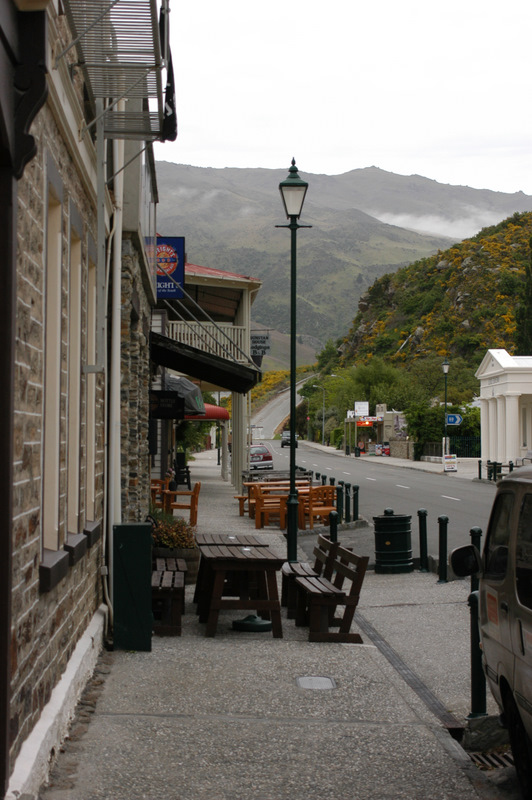
Omakau is right on the rail trail, and after a little while exploring the old railway station site, we rolled into town. The weather was fine and there was plenty of daylight left, so we decided to take the short detour to the nearby town of Ophir, about 2km away. We rolled across a flat farming plain, before ending up on the short main street of Ophir. The town certainly is worth the detour - the whole place looked like a time capsule from yesteryear. As with most of the towns we visited, the old buildings of Ophir were far from stagnant, and were still being used as shops, post offices and houses. This sense of living history is one of the great delights of Central Otago, where everything is as it was back in the day, but the people haven't let time stand still. We rolled through Ophir and soon ended up at the historic Daniel O'connell suspension bridge. As we stood there marveling at the amazing stonework and engineering in the bridge, a little bus turned up and disgorged a heap of cyclist looking types - it was the same people we had seen riding along the trail earlier in the morning. I got talking to the tour guide, and apparently they left their bikes on the trail, and got a lift the 2km to check out the bridge. They weren't going into Omakau, but heading straight back to the bikes and continuing along the trail until much later in the day. This seemed strange and lazy to me - I was very much enjoying transitioning from place to place in Central Otago, and spending the time at each location to get a feeling for the history and the landscape. I almost felt sorry for these people that they were missing out on all that, only getting a fairly condensed and I imagine somewhat sterile version of the experience we were having.

The bridge seems almost excessively grand to cross a small creek in a pretty remote location

I'm no bridgeologist, but I reckon these doors probably contain the drums to wind tension on the cables. Can anyone tell me if this is correct?

Jer looks on as the cycle tour group quickly swarm over the bridge then zoom off again, back to their bikes on the trail
Kicking back in Omakau
Kicking back in Omakau
After exploring the bridge for a while, we pedalled back to the town of Omakau, to our accommodation at the Omakau Commercial Hotel. We were greeted by the enthusiastic manager Matt, who showed us around the old building and grounds. Originally built in 1898 as a boarding house, the hotel has been lovingly restored by the current owners, Stacey and Mike. Actually, to say it's lovingly restored is a huge understatement - this building goes beyond a labour of love, and the effort and results of the restoration puts it in a league of its own. The accommodation and dining areas have been tastefully refurbished to what I imagine would have been the height of luxury in the early 1900s - it's a real treat. I've been in a lot of old pubs before and generally the tag "historic" means they are pretty ratty, and "restored" often means they have been gutted and refitted with whatever interior is the trend of the day - but not the Omakau Commercial Hotel. The attention to detail is quite spectacular, and all the luxurious touches were very much appreciated by two cycle tourers who were used to pretty basic accommodation. The building was without question the most welcoming hotel I have ever set foot in.

Bikes were well catered for at Omakau - I still having trouble getting my mind around the warm acceptance of bicycles in all these tiny Central Otago towns

The library and sitting room at the Omakau Commercial Hotel - I felt like some sort of James Bond super villain lounging around in here. Note the ghostly figure in the mirror

Inside the huge building was a labyrinth of rooms and passageways. I found it difficult to photograph - there were lots of atmospheric nooks and crannies that all contributed to the overall vibe of the place

As per usual, we managed to make our rooms look like a pannier bomb had exploded in them within about 15 seconds of arriving

The owners must have read the blog to learn more about us - Jer's room was equipped with a ladies vintage grooming station, complete with mirror and dainty hairbrush for his long girly locks. These kind of little touches everywhere made staying at the Omakau Commercial Hotel such a great experience
My room looked to me like some kind of 1908 version of a presidential suite, and was even equipped with bathrobes (rare for a pub), which I duly put on and strutted around the upper floor of the hotel. As I was swanning around checking the place out I bumped into a group of arriving cyclists, who clearly though I was pretty weird getting around in my scandalously short gown at 3pm in the afternoon - I later realised that I was actually sporting the "hers" robe! After a long shower we headed out into town to see what was happening.
Omakau is only a tiny place, but like everywhere we went in Central Otago, it had a strangely energetic vibe. The town had all the usual small town things like a pub and a service station and a library, as well as a very modern bike shop, and a lot of boutique accommodation catering to cyclists. As we wandered around we saw a lot of people riding around in town, clearly from the trail. I already thought Central Otago was a great place, regardless of the cycling aspect - the fact that it was so bike friendly was fast cementing it in my mind as some kind of cycle touring paradise.

If you're ever in Omakau, you NEED to go to the antique shop across the road from the hotel. Or is it a junk shop? I don't know, but it was the craziest collection of crazy crap I've ever seen, jammed into a little room, and all for sale! Plus the guy that runs the place is a very funny man and a total legend

We stopped in here for afternoon tea, I had coffee and piece of cake. The cake and coffee was great, but what I should have done was had a pie. Apparently this place makes legendary pies, and later in our journey a few Kiwis chastised me for not getting a Muddy Creek Cafe pie. I guess it means I need to go back to Central Otago and redeem myself
Our night at Omakau was the first and only night of the entire tour where Jer and I had seperate rooms, so naturally we were keen to spend some time apart after two weeks straight of living in each others pockets. We decided to throw competing parties in our hotel rooms, to which the other person wasn't invited. We headed to the local 4 Square supermarket for supplies, then retired to our respective rooms to party down.

My room party involved me eating chips, drinking L&P and reading all the awesome historical information in the room provided by the hotel. Jer's party involved eating pineapple lumps and playing a Sega Megadrive emulator on his laptop. I'm confident my party was the winner
We reconvened in the bar to have a few beers and dinner at the hotel. We sat outside in the warm afternoon sun having a pint and watching the world go by - a world that seemed to consist of a cyclist arriving every five minutes or so. It happened that the hotel was completely booked out that night with rail trail travelers, which certainly made for a lively atmosphere when we went back inside. It was a little odd to be standing inside a remote country pub listening to a room full of bar chit-chat about derailleurs and elevation profiles and sore bums - I imagine the original bar conversations in 1898 could not have been more different. After dinner I was heading back up to my room when I bumped into Matt, the manager of the hotel. He asked if I'd like to see the original stables at the back of the hotel, near where I had parked my bike - it turns out it's where they filmed some of the Speight's beer commercials back in the day.

The old stable is made of Otago schist rock, and is one of the original buildings in Omakau

As with the main building of the hotel, the interior is full of historical artefacts from around the area. The bar is instantly recognisable to those who are familiar with the beer commercials
After checking out the old stable, which had found a new purpose as a building for private functions, I went back to my room to lie around on the bed and reflect on my first day on the Central Otago Rail Trail. So far the trail had exceeded all my expectations, and I was completely spellbound by the places we'd visited and things we'd seen every step of the way. Something about Central Otago was having a profoundly calming effect on me, and I lay there feeling tired and content, and excited about what unexpected delights the next day on the trail would bring. Of course, the day still had one final treat in store - for the first time in two weeks I was able to drift off to sleep without being subjected to the nocturnal sonic juggernaut that is Jer's snoring. All was peaceful in Central Otago.